


When it comes to reclaiming your health, you may feel a strong urge to jump straight into ‘deep clean’ mode. Whether you are dealing with persistent fatigue, skin issues, or the lingering effects of environmental toxins, a heavy metal detox may sound like the ultimate fresh start for you. However, as board-certified nurse practitioner Ishani Shah often emphasizes, jumping into a detox without preparation is like trying to flush a high-pressure fire hose through a clogged sink. You would be putting in effort and getting nowhere.
In the world of root cause health solutions, we don’t just look at the toxins themselves. We look at the ‘pipes’ they must travel through to leave your body. These are your drainage pathways. If these pathways are blocked, those mobilized toxins – mercury, lead, or aluminium – simply recirculate, leading to what we call a ‘healing crisis’ or ‘Herxheimer reaction.’
To truly heal, we must first ensure the exit doors are wide open.
Defining the Problem: The Detox vs. Drainage Trap
Most people use the words “detox” and “drainage” interchangeably, but in functional medicine, they represent two distinct phases of cellular housecleaning.
- Detoxification is an active, biochemical process. It involves your liver grabbing a toxin, neutralizing it, and preparing it for transport.
- Drainage is the passive flow of those neutralized toxins out of the body.
If you start an aggressive detox protocol – using binders like chlorella or chelators like EDTA – without supporting drainage, you are mobilizing “trash” into a hallway with no exit. This is why a functional health assessment is so critical; it identifies where the “kinks in the hose” are before you start the heavy lifting.
Research highlights that the lymphatic system, for instance, acts as a primary detoxifying organ, draining toxins from the connective tissue matrix (Broadfoot, n.d.). If this slow-moving system isn’t prepared, the “pressure” of the detox can damage the very tissues you are trying to save.
Why Pathways Clog: The Hierarchy of Drainage
To understand why your body might be struggling to eliminate waste, we have to look at the hierarchy of drainage. Think of it as a funnel:
- The Colon (The Bottom of the Funnel)
If you are not having 1-3 easy bowel movements a day, you are not ready to detox. When waste sits in the colon too long, toxins are reabsorbed through the intestinal wall and sent straight back to the liver. This “first pass effect” ensures that the liver filters all blood from the gut, but an overloaded gut creates a vicious cycle of toxicity (Broadfoot, n.d.).
- The Liver and Gallbladder (The Processing Plant)
The liver is your body’s filter. It performs Phase I and Phase II detoxification, making lipophilic (fat-soluble) toxins water-soluble for excretion via the kidneys or bile (Broadfoot, n.d.). If bile flow is sluggish (cholestasis), those toxins stay trapped in the liver, leading to inflammation and “sluggish liver” symptoms like brain fog and hormonal imbalances (Glance, 2017).
- The Lymphatic System (The Cellular Vacuum)
The lymph system is responsible for circulating most of the extracellular fluid and draining the interstitial space (Broadfoot, n.d.). Unlike your blood, which has the heart to pump it, lymph depends on movement and pressure. When the lymph is stagnant, your cells are essentially “sitting in their own waste.”
The Solution: A Functional Approach to Opening the Gates
Before you reach for a heavy metal binder, a Nurse practitioner functional medicine specialist like Ishani Shah would recommend a “Drainage First” protocol. Here is how you can systematically open your pathways:
Step 1: Hydration and Mineral Balance
Dehydration concentrates metals and reduces renal (kidney) excretion (Matter, 2026). However, water alone isn’t enough. You need minerals like magnesium and potassium to ensure that water actually enters the cells to flush out waste.
Step 2: Support Bile Flow
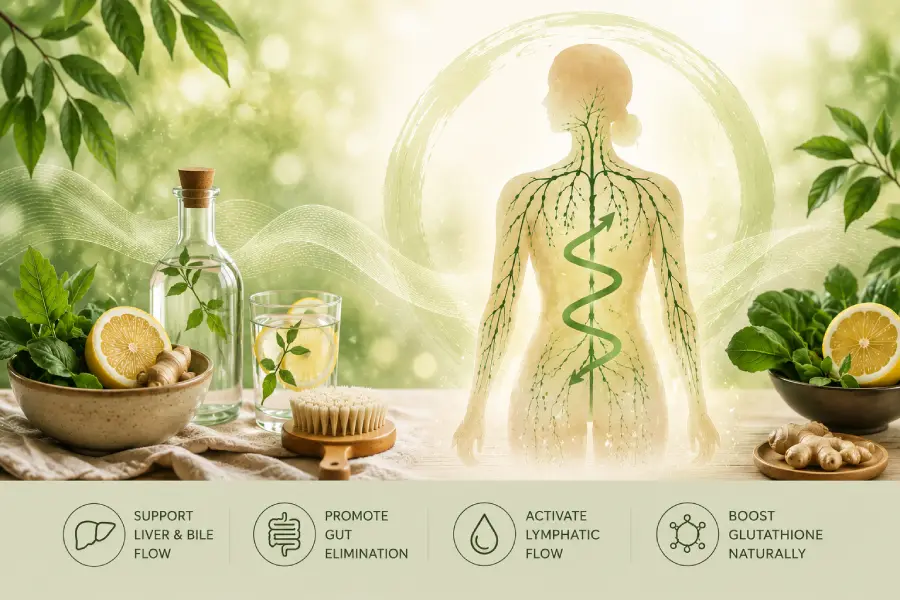
Bile is the “taxi cab” that carries toxins from the liver to the colon. You can support this by:
- Eating bitter greens (arugula, dandelion) to stimulate bile production.
- Using TUDCA or Milk Thistle to protect hepatocytes and improve flow (Glance, 2017).
Step 3: Move Your Lymph
Since the lymph has no pump, you must be the pump. Infrared sauna sessions (3-5 times a week) are highly effective for mobilizing toxins through the skin, while dry brushing and rebounders (mini-trampolines) help move fluid toward the truncal vessels for elimination (Matter, 2026; Broadfoot, n.d.).
Step 4: Upregulate Glutathione
Glutathione is your body’s “master antioxidant.” Research suggests that N-Acetyl Cysteine (NAC) at 600 to 1200 mg/day is a primary way to provide the rate-limiting precursors for glutathione synthesis, ensuring your liver has the “fuel” it needs for Phase II detox (Matter, 2026).
The Role of Professional Guidance
Detoxing is a high-stakes biological process. This is why working with a Nurse practitioner functional medicine expert is invaluable. Through a functional health assessment, a practitioner can look at your specific genetic markers (like MTHFR or COMT), your current toxic load, and your “drainage capacity.”
By seeking root cause health solutions, you stop chasing symptoms and start supporting the biological systems that were designed to keep you clean. As board-certified nurse practitioner Ishani Shah often reminds her patients: “Healing is not about forcing the body to change; it’s about removing the obstacles so the body can do what it does best – thrive.”
References:
Broadfoot, P. J. (n.d.). Basic antihomotoxic agents for detoxification. CABI Digital Library. https://www.cabidigitallibrary.org/doi/pdf/10.5555/20113161426
Glance, D. A. A. (2017). Signs of a sluggish liver and symptoms of a congested liver. Dr. Sarah Williams. https://drsarahwilliams.com/signs-you-might-be-suffering-from-a-sluggish-liver/
Matter, W. D. T. (2026). How to reduce heavy metal exposure and support detoxification naturally. Mito Health. https://mitohealth.com/guide/reducing-heavy-metal-exposure-naturally/
Semyachkina-Glushkovskaya, O. V., Postnov, D. E., Khorovodov, A. P., Navolokin, N. A., & Kurthz, J. H. G. (2023). Lymphatic drainage system of the brain: A new player in neuroscience. Journal of Evolutionary Biochemistry and Physiology, 59, 1–19. https://doi.org/10.1134/s0022093023010015
Ready to transform your health from the inside out?
Don’t let stagnant toxins hold you back from feeling your best. Whether you’re looking to clear the fog, heal your gut, or simply hit the reset button, the right support makes all the difference.
Take the first step toward a revitalized you. Get a free 15-minute consultation